Wolf-cop war
Stolen WanderThe Wolf-cop war is the feud between the Sons of Wolves Motorcycle Club and Salem’s police, a conflict that turns suspicion and institutional pride into the imminent threat of armed violence. Its defining confrontation takes place in a bar: police and bikers aim guns at one another until Nancy O’Neill forces both groups to consider what their escalation is costing them. The war ends not with a victory for either side, but with Ralf Michaels backing down and the club’s Old Man refusing to let the fight resume.
Background and Sources of Escalation
The feud is dangerous beyond any single confrontation because Rex Foster knows how quickly the club can retaliate against police. While trying to find Nancy, he avoids going to the club because its members might become angry and start harassing the cops again. He is looking for help, but fears that seeking it through his own community will reignite the conflict. His hesitation makes the feud an obstacle to personal action as well as a threat of collective violence.
The club’s internal responsibilities also surface in the Old Man’s rebuke of Rex for failing to answer a call. The Old Man reminds him that the club needed him for a protection job: four men and one truck had been planned, but Rex’s absence left three men and one truck. He stresses that one of Rex’s brothers could have died. This exchange is not identified as a police encounter, but it establishes the obligations and risks within the club that form the other side of the story’s conflict between police and bikers: members act as a brotherhood, while their choices can expose one another to danger.
The conflict also intrudes into private life through Bill O’Neill, Nancy’s father and a sheriff. When Rex comes to Bill’s apartment, Bill threatens to summon police friends and have Rex arrested, claiming that they would say they had seen him pull a gun. Bill later meets Rex at the door with a shotgun, explaining that Nancy had taken his pistol and he had obtained an upgrade. This encounter is not the bar standoff, but it makes the feud’s power imbalance personal: the possibility of police force appears not only in a crowd of officers but in a family dispute involving Nancy’s outlaw partner and her law-enforcement father.
The Bar Standoff
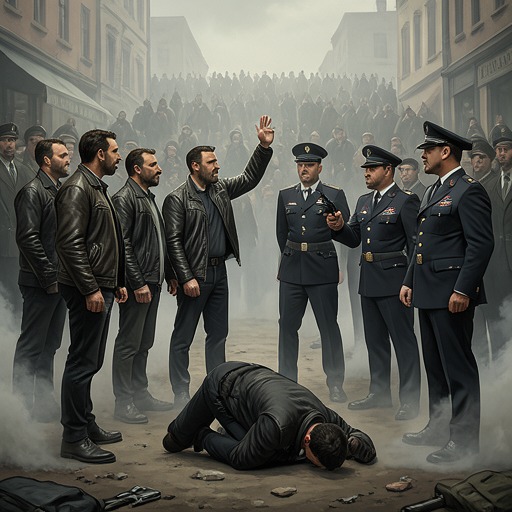
The immediate crisis begins when Ralf Michaels arrives at the bar with thirteen men behind him. Though dressed in civilian clothes, they walk with the bearing of police officers. The club’s boss addresses Michaels as an officer and offers drinks, attempting to keep the exchange from becoming a fight even as anger shows through his response. The gathering brings the feud into a crowded social space, where each side’s show of strength is visible to the other and to the people around them.
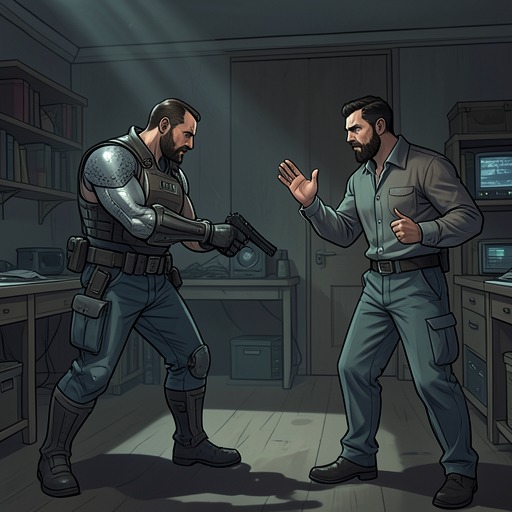
Rex tries to prevent a fight between himself and Michaels from becoming a pretext for further conflict. He calls for everyone present to recognize that the two men have agreed to fight, and warns that no one should later claim the encounter was unfair or turn it into an excuse to intervene. His insistence on making Michaels’ choice visible to the room is a practical attempt to contain violence through public accountability. It also exposes how fragile that restraint is: the confrontation still ends with Michaels drawing a hidden handgun and pressing it against Rex’s forehead.
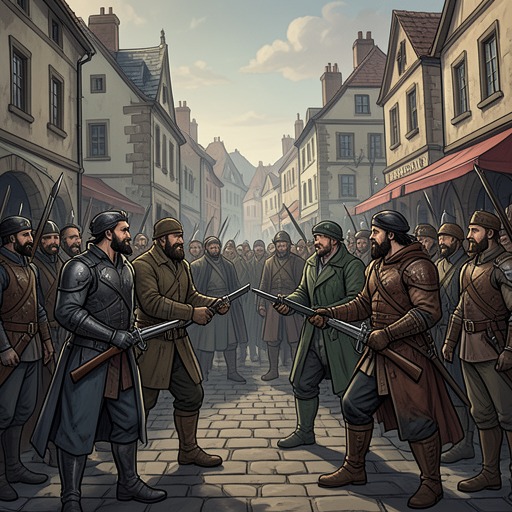
The threat immediately expands beyond the two men. Police officers and bikers draw their guns and aim at one another as Michaels stands over Rex. At that point, the feud has become a collective armed standoff: a single man’s humiliation and decision to pull a weapon could trigger violence between the assembled groups. The scene sharply contrasts the language of legitimate policing with the behavior on display. Michaels appears among officers, but his gun aimed at an unarrested man and the reciprocal line of weapons have moved the confrontation far from an ordinary police procedure.
Nancy’s Intervention and the End of the Feud
Nancy enters while Michaels still has his gun on Rex. Rather than appeal only to the danger facing the couple, she addresses the police and bikers together, asking them to consider whether the conflict serves Salem, their families, their ambitions, or their futures. She points to the pensions and retirement plans the officers stand to lose, and invokes the period when her father was sheriff to question whether threatening an unarrested man represents the kind of police work they want to defend. Her appeal redirects attention from the opposing group to the choices each person is making and the consequences those choices carry beyond the bar.
The men begin lowering their guns as Nancy speaks. Michaels and Snake are the exceptions: Michaels still aims at Rex, while Snake keeps his weapon trained on Michaels in case he needs to avenge Rex. Nancy’s intervention has changed the balance of the room, but the danger remains concentrated between these three men. Rex then gives Michaels a stark choice—kill him or lower the gun—and Michaels finally backs down, curses, and says the feud is over. He directs the declaration to the club’s boss and says he wants nothing more to do with the conflict.
Nancy makes the end tangible by slapping Michaels hard enough to make him drop his handgun, then warning him never to point a gun at Rex again. Michaels leaves, followed by his men. When Snake starts to argue for killing them, the Old Man stops him and confirms that the feud is finished. The club’s decision not to pursue the departing officers matters as much as Michaels’ withdrawal: the confrontation ends because both sides cease escalating, not because one has destroyed or subdued the other.
Significance
The Wolf-cop war is presented as a cycle sustained by pride, perceived disrespect, and the readiness to answer a threat with greater force. At the bar, police officers and bikers form opposing armed lines, while Michaels’ conduct makes the distinction between public authority and personal intimidation difficult to maintain. Rex’s attempt to make the fight accountable and Nancy’s appeal to the men’s families, futures, and professional standing offer different forms of restraint; neither can guarantee safety, but together they create room for the guns to come down.
The resolution is therefore a fragile, deliberate cessation rather than a triumph. Michaels disavows the feud, the club’s Old Man rejects retaliation, and the armed crowd disperses without the shooting that had seemed seconds away. For Rex, this outcome also avoids the renewed police harassment he feared if the club became involved in his search for Nancy. The war’s end clears a path away from collective confrontation, while showing that its continuation would have depended on the same choices—whether to treat humiliation as a reason to escalate, or to let the conflict stop.